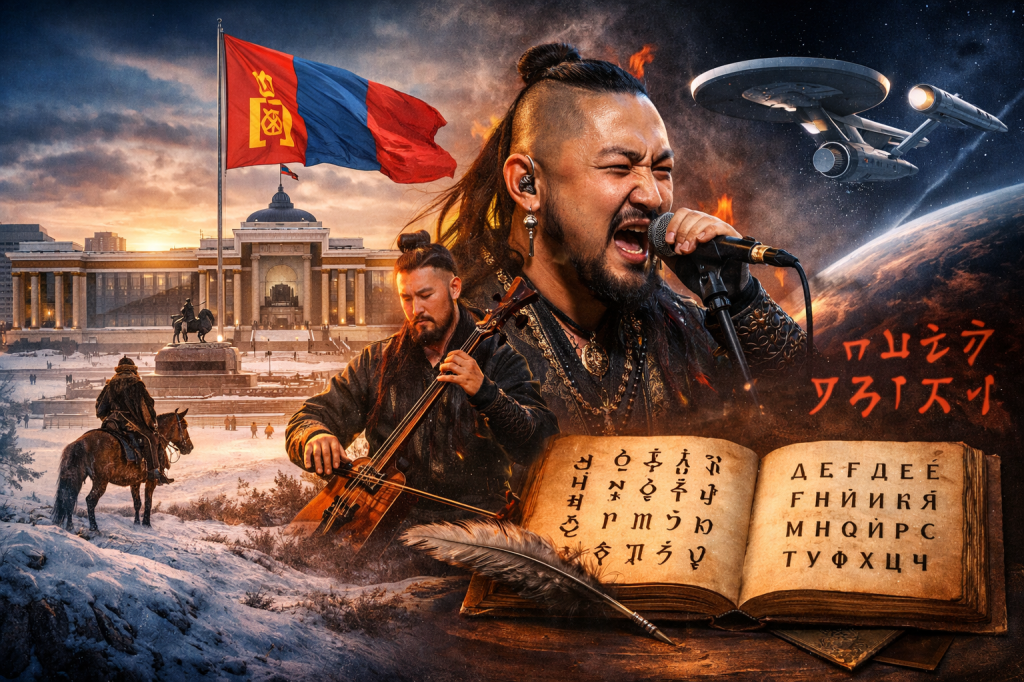
Today, December 29, is Mongolia’s Independence Day — a date that rarely appears on international calendars, yet carries a quiet, enduring gravity.
On December 29, 1911, Mongolia declared independence from Qing rule, reclaiming sovereignty after centuries of external control. It was not a loud revolution. It was an act of remembrance — a return to selfhood rather than a reinvention. Even today, the day is observed with dignity more than spectacle. Flags rise. Ceremonies unfold. The tone is reflective, almost inward. That restraint feels very Mongolian.
Mongolia is a place defined by vastness: open steppe, extreme seasons, long silences. Cultures that grow in such conditions do not rush. They listen. They wait. They value attunement over urgency. You can hear this sensibility everywhere — in traditional music, in ceremonial rhythms, in how sound is allowed to stretch instead of being crowded. Silence isn’t absence. It’s structure.
One detail often surprises people: modern Mongolian is written primarily in Cyrillic.
In the 1940s, Mongolia adopted a modified Cyrillic alphabet to increase literacy and printing efficiency during a period of Soviet influence. Two additional letters — Ө and Ү — were added to preserve distinct Mongolian vowel sounds. What matters most, though, is what didn’t disappear. Oral traditions remained intact. Throat singing endured. The ancient vertical Mongolian script survived quietly and is now being revived. The alphabet changed. The voice did not.
Speaking of throat singing: My personal reason for writing this post arrived not through history books but through sound. Some time ago, I came across a Mongolian metal song by Uuhai. Indeed, it features throat singing. I didn’t understand the words, and I didn’t try to translate them. The language itself landed first — heavy consonants, open vowels, grounded syllables that felt placed rather than rushed. It was immediately compelling.
Instead of chasing meaning, I listened to phonetics — how the language moved, where it lingered, how it carried authority without aggression. The sound felt ancient and futuristic at the same time. And something unexpected happened. I began creating snippets of a language of my own for a sci fi/fantasy book I am writing.
Before grammar, before vocabulary, language is nervous-system architecture. Some sound patterns feel sharp and combative. Others feel expansive, ceremonial, stabilizing. Mongolian — especially when fused with metal — carries a sense of terrain. You can hear space in it. Distance. Endurance. That made it the perfect seed for a fantasy language — not one designed to be decoded word-for-word, but one meant to signal culture instantly. A language that feels right before it explains itself.
This instinct wasn’t new. It simply resurfaced. I’ve been fascinated since childhood with Star Trek, especially the original series — not just for its stories, but for its audacity. Star Trek didn’t merely imagine new worlds. It gave them languages. The Klingon language wasn’t invented to sound beautiful. It was invented to fit a people. Harsh phonemes. Guttural stops. An unapologetically non-human structure. Sound alone told you who these beings were.
So, when Mongolian metal crossed my path, it didn’t feel random. It felt like recognition. Metal, Cyrillic letters, ancient scripts, throat singing, Klingon, fantasy world-building — these aren’t disconnected fascinations. They’re expressions of the same impulse: to give sound to identity and to imagine worlds where that sound belongs.
Mongolia’s Independence Day isn’t only about borders. It’s about maintaining internal grammar while adapting external form. About changing scripts without losing voice. That idea mirrors something I didn’t fully recognize at first.
The fantasy world I created didn’t begin with sound. It began with place, structure, and a sense of planetary logic — landscapes, cultures, tensions, and histories already in motion. The snippets of a language arrived later, not as a blueprint, but as a beautiful addition. A refinement. A way to give that world a deeper resonance once it already knew who it was.
When the Mongolian language entered that process — through music, through phonetics, through cadence rather than translation — it didn’t overwrite the world. It tuned it. It added texture and gravity, the way a voice changes a room without rearranging the furniture.
That feels fitting. Mongolia’s story isn’t about erasing what came before. It’s about continuity — about allowing form to evolve while essence remains intact. The same is true here. The language didn’t create the world. It revealed something the world was already prepared to say.
And like Mongolia itself, that voice carries an ancient cadence into a future that doesn’t need to be rushed or explained — only listened to.
 A Heep of Words: Books by Alexandra Heep, Helena Parx, Lexa Drane
Leave a comment