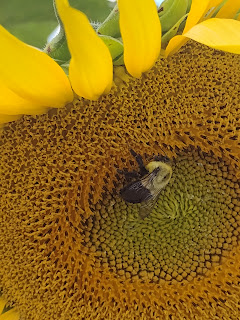
If bees had a Food Day, it wouldn’t start with breakfast. It would start with a sunrise.
The hive would hum a little louder as light filtered through clover and wild mint. The air would taste faintly of rain and something sweet just about to happen. A good day for nectar, they’d say — if bees said things out loud.
They’d celebrate the unseen: the way petals open like doors, how pollen dusts the air like golden punctuation, how wind and wings write invisible recipes across fields. Their Food Day wouldn’t be about consumption but connection — every sip, every grain, every landing a shared act between flower and flight.
But if bees looked at how humans celebrate National Food Day, which is today, October 24 in the USA, they might tilt their striped heads in confusion. We cheer for kale and quinoa, debate the ethics of organic versus local, invent hashtags about “clean eating,” create food insecurity for all that lives, including other humans.
Meanwhile, their clover patches shrink beneath concrete, and the blossoms arrive weeks too early or too late.
If bees had feelings about irony, this might be one of them.
In reality, bees are the quiet partners behind every harvest. Their pollination powers fill about a third of our plates. But lately, they’ve been sending distress signals — fewer flowers, fewer foragers, fewer safe places to rest.
Not all signals come as sound. Some arrive cloaked in silence.
When bees go quiet, the fields follow. So do we, eventually — our own bodies reflect the same imbalance through allergies, inflammation, and exhaustion. My book, Bees, Biofeedback, and the Living Warning System, explores that mirrored fragility: how the nervous systems of humans and hives both depend on rhythm, diversity, and communication.
When one species loses its hum, others begin to lose theirs too.
Still, this isn’t a story about despair (neither is the book). Bees wouldn’t tell it that way. They’d nudge us toward remembering.
They’d remind us that “food” doesn’t start in grocery aisles; it starts with roots, wings, and weather. They’d point out that a single backyard bloom can feed hundreds of tiny travelers, and that even small acts — leaving a patch of clover uncut, planting wildflowers in a balcony pot, skipping the pesticides — ripple outward more than we realize.
If bees hosted a Food Day festival, everyone would be invited: ants, butterflies, humans, even the wind. The menu would be humble but sacred — sunlight, soil, water, and time.
Maybe that’s the message this National Food Day needs most.
Not perfection. Not guilt. Just a return to awareness — to the hum beneath every meal, to the miracle that something so small keeps so much alive.
We don’t need to save the world all at once; we just need to stay in conversation with it.
So today, instead of snapping pictures of lunch or debating diets, maybe step outside and listen. There’s a sound the world makes when it’s still thriving — a gentle buzz that says, we’re still connected, you and I.
If bees had a Food Day, that’s probably how they’d celebrate:
Not with noise, but with notice.
Not with feasts, but with flowers.
And not with slogans, but with the steady hum of belonging.
Here’s to feeding the world the way bees do — by giving back more sweetness than we take. 🐝
 A Heep of Words: Books by Alexandra Heep, Helena Parx, Lexa Drane
Leave a comment