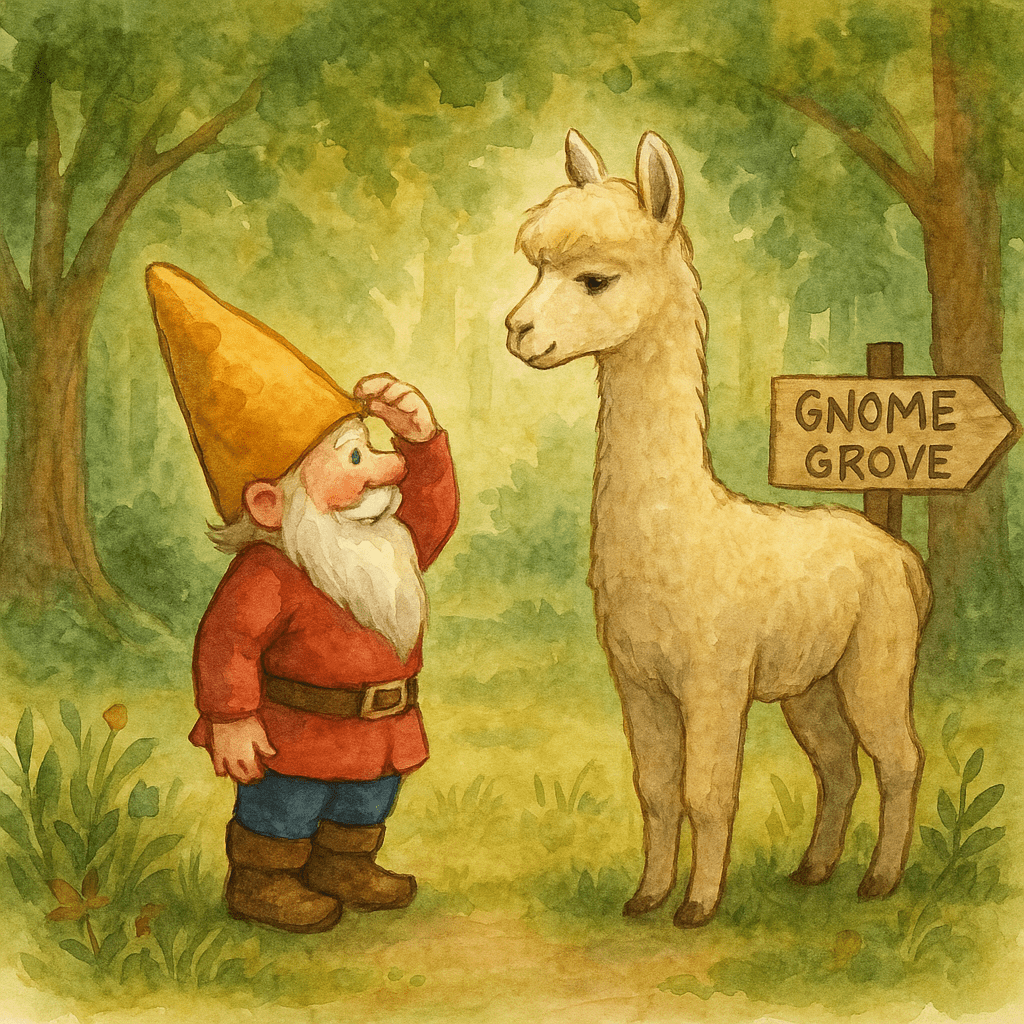
When I wrote The Gnome with the Golden Hat, I had absolutely no intention of turning gnomes into a series. After all, I was out of blank gnomes to paint, and that felt like a perfectly reasonable stopping point.
But here’s the thing about stories: they’re like glitter. Once you spill a little, it’s everywhere.
For years, I’d toyed with the idea of writing a book about alpacas — we’ve visited them annually for ages, and I’ve yet to meet one that didn’t look both deeply wise and slightly unimpressed by humans. Still, no story ever quite came together.
Then the first gnome book was published, and readers actually loved it. Suddenly, the wheels in my head started turning again (quietly, but persistently — like gnomes whispering in the background). Around that same time, the farm we visit — home of said alpacas — installed a full-blown gnome grove. I took that as a sign.
The owner of the farm, who built the grove and rescued most of the animals there, graciously gave me permission to use her photo of the Gnome Grove sign and to base parts of the setting on her beautiful property. That generosity became the heart of the story: a place where care, rescue, and quiet magic all intersect.
So instead of writing an alpaca story, I decided to write a gnome story with alpacas in it. Because, why not? Gnomes have opinions, alpacas have expressions, and I apparently have a soft spot for both.
Naturally, I kept my cat as the narrator. Princess Gracie had already proven herself to be the perfect mix of skeptical observer and accidental philosopher. Besides, she’d been watching the gnomes (figurines in my house and outside) long before I ever thought to write about them — she just needed a typist.
And that’s how the seeds for Gnome Too: The Gnome Grove Gem were planted. As for the gem part — well, I’ve been studying metaphysical gemstones for decades. It was only a matter of time before they demanded their own subplot.
If you noticed Gnome Too instead of Gnome Two, that’s not a coincidence. It was my first attempt at playing around with puns. The second came with naming the series Gnomeward Bound. But they didn’t fully take off until the third book.
Meanwhile, here’s a small glimpse from the prologue of book two — where moss, mystery, and a touch of mischief first meet.
Beneath the gentle slope of what locals liked to call the safe house, the earth had been awake for centuries. Perhaps longer. Long before people thought to pound posts into the ground or drape cheerful banners over fences. Long before curious children pointed at shaggy alpacas or tossed feed to ducks that strutted around like minor nobility.
Long before that, the earth simply listened.
It listened to water trickling through secret veins. To worms threading ancient tunnels. To stones sighing in their slow, endless shifts. And at the very heart of this listening lay the Lepidora—a slumbering stone heart, quietly patient, humming now and then as if to remind itself of old promises.
Humans who cared about such things would have called it lepidolite—a humble mineral, lilac-gray to green, speckled with tiny flakes of mica that caught the light like frost. In certain human circles, it was known as the “stone of transition,” thought to ease shifts from one life chapter to another.
But here, deep in the grove, it was something far older and more deliberate. The Lepidora, nestled at its core, was unlike any ordinary stone. Roughly the size of a curled hedgehog, it was a tangled mass of crystalline filaments and dark mossy inclusions, as if someone had taken forest floor and starlight and pressed them together until they whispered secrets.
Veins of soft green and deep violet threaded through its body, glowing faintly whenever the grove breathed—not with the harsh sparkle of jewels, but a gentle, pulsing luminescence that felt more alive than mineral. Tiny motes of golden dust drifted around it, settling into hairline cracks before drifting off again like dandelion seeds.
When you looked too long, its surfaces seemed to shift—edges smoothing into curves, then fracturing into delicate facets, then back again—a living puzzle that never quite settled into one shape. Even the moss at its base seemed to lean toward it, cradling it like small green hands.
 A Heep of Words: Books by Alexandra Heep, Helena Parx, Lexa Drane
Leave a comment